How pastoralist women’s “lived data” can save Kenya’s climate future, if we let them lead.
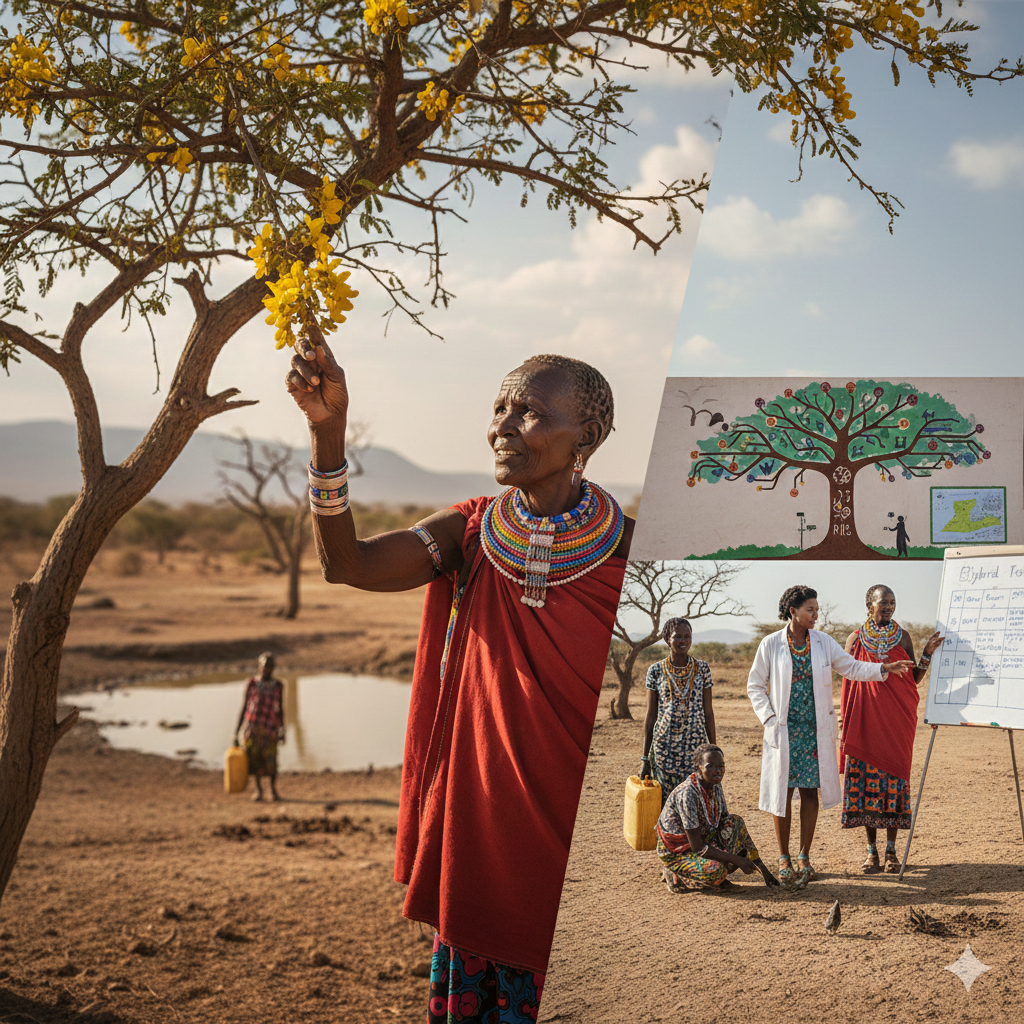
In Marsabit County, an elder woman watches the flowering of the Acacia tortilis. She knows the rains will be late, even if her radio says otherwise. She is rarely wrong. Yet, when the Ministry of Environment or ICPAC (IGAD Climate Prediction and Applications Centre) meets to plan for the next drought, her voice is missing. This isn’t just an oversight; it is a violation of her rights.
The Power of Local Eyes
Pastoralist women are the “hidden hands” of climate resilience. While scientific models use satellites, these women use generations of biological cues, tracking water quality in boreholes and the health of small livestock. According to NDMA (National Drought Management Authority) 2025 assessments, over 1.2 million women in ASAL counties faced acute malnutrition. These women are the first to feel the crisis, yet their specialized survival knowledge is often dismissed as “anecdotal.”
Evidence: The Power of Inclusion
When we listen, the results are measurable. In Western Kenya, the Kenya Meteorological Department (KMD) began blending scientific data with the traditional “rainmaking” wisdom of the Nganyi community. By including women elders in “translating” these forecasts into local metaphors, like bird migration and tree budding, the community’s trust in weather alerts surged. This hybrid approach led to a 30% increase in the uptake of drought-resistant seeds, proving that scientific accuracy only works when it respects local intelligence.
The Law vs. The Reality
Kenya has strong legal frameworks, but there is a “Green Rights” gap:
- The Climate Change Act (2016): Mandates public participation and recognizes traditional knowledge.
- National Climate Change Action Plan (NCCAP III 2023-2027): Lists gender as a top priority for adaptation.
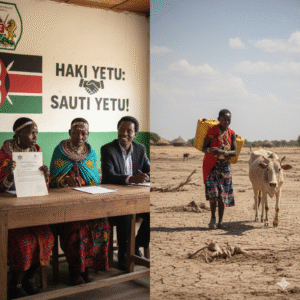
The Gap: Despite these laws, implementation by the National Climate Change Council remains top-down. Participation is often a “tick-box” exercise in Nairobi boardrooms rather than a deep dive into the manyattas. Ignoring these women violates Article 10 of our Constitution, which demands inclusive governance. Justice is only served when the woman under the acacia tree is recognized as a scientist.
Reference List
- Constitution of Kenya (2010): Articles 10 & 69 (Participation and Environmental Rights).
- Government of Kenya (2016): Climate Change Act, 2016.
- Government of Kenya (2023): National Climate Change Action Plan (NCCAP III) 2023–2027.
- NDMA (2025): Long Rains Food and Nutrition Security Assessment.
- The Star/KMD (2025): Traditional rainmakers to help Met experts in predicting weather.